Effect of calcium dobesilate on liver regeneration in rats undergoing partial hepatectomy
Gizem Fırtına1, Hamdi Taner Turgut21Department of Gastroenterology Surgery, Trabzon Training and Research Hospital, Health Sciences University, Trabzon-Türkiye2Department of General Surgery, Kocaeli City Hospital, Kocaeli-Türkiye
BACKGROUND: To date, no study has evaluated the effects of calcium dobesilate on regenerative capacity after partial hepatectomy. Within the scope of this research, we aimed to elucidate the effects of calcium dobesilate (CD) on liver regeneration capacity and antioxidant pathways after partial hepatectomy.
METHODS: Thirty-six Sprague Dawley male rats weighing between 250-350 grams were used in the study. All animals underwent partial hepatectomy. The rats were randomly divided into four groups, each consisting of nine rats, as control groups (Groups 1 and 2) and study groups (Groups 3 and 4). Regeneration rate, histopathological parameters, immunohistochemical examination, and the apoptotic index (AI) were measured.
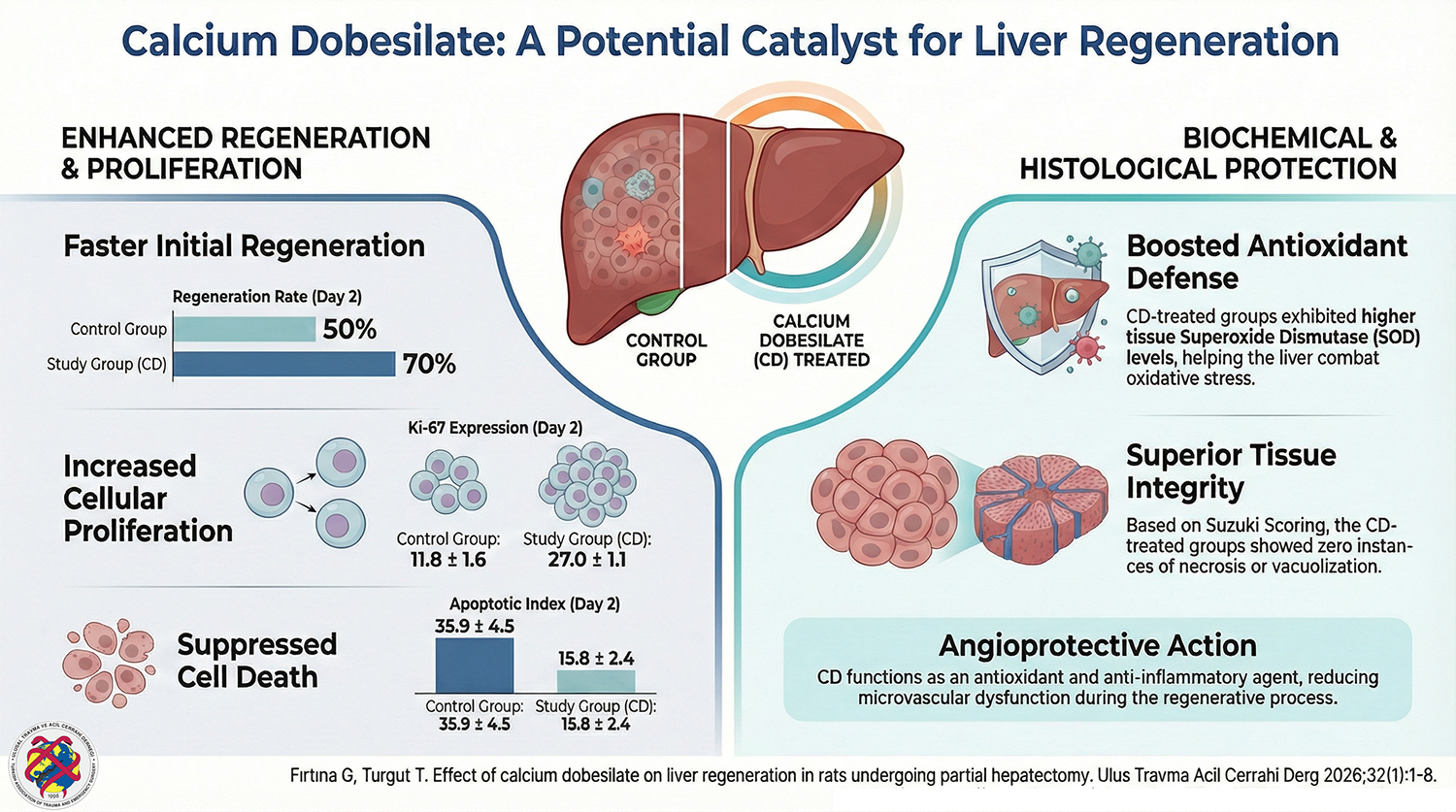
RESULTS: Tissue superoxide dismutase (SOD) levels were statistically significantly higher in the calcium dobesilate study groups compared to controls (p=0.03). Malondialdehyde (MDA) levels were statistically significantly higher in the study groups than in the control groups on both the second and seventh days (p=0.001). The regeneration rate (RR) was higher in the study group compared to the control group on the second day, and this difference was statistically significant (p<0.001). RR was also significantly higher in the study group on the second day compared to the seventh day (p<0.001). According to the Suzuki Scoring System, vacuolization and necrosis were not observed in the study groups (p<0.001 vs. p=0.034, respectively). The apoptotic index was significantly higher in the control groups compared to the study groups (p<0.001), and AI was statistically significantly lower on the seventh day (p=0.006). Ki-67 expression was statistically significantly higher in the groups receiving CD treatment on both the second and seventh days. In the control groups, Ki-67 expression was statistically significantly higher on the seventh day compared to the second day (p=0.006).
CONCLUSION: This research indicated the effects of calcium dobesilate on improving oxidative damage and liver regeneration in rats undergoing partial hepatectomy. The results of the present study showed that (preoperative-postoperative) CD improves oxidative stress and increases liver regeneration capacity after partial hepatectomy.
Keywords: Calcium dobesilate, liver regeneration, oxidative damage, partial hepatectomy, experimental.
Parsiyel hepatektomi yapılan sıçanlarda kalsiyum dobesilatın karaciğer rejenerasyonu üzerine etkisi
Gizem Fırtına1, Hamdi Taner Turgut21Gastroenteroloji Cerrahisi Bölümü, Trabzon Kanuni Eğitim Ve Araştırma Hastanesi,trabzon, Türkiye2Genel Cerrahi Bölümü, Kocaeli Şehir Hastanesi, Kocaeli, Türkiye
AMAÇ: Bugüne kadar hiçbir çalışma, kalsiyum dobesilatın parsiyel hepatektomi sonrası rejeneratif kapasite üzerindeki etkilerini değerlendirmemiştir. Bu araştırma kapsamında, kalsiyum dobesilatın (KD) parsiyel hepatektomi sonrası karaciğer rejenerasyon kapasitesi ve antioksidan yolakları üzerindeki etkilerini açıklamayı amaçladık.
GEREÇ VE YÖNTEM: Çalışmada 250 ile 350 gram ağırlığında otuz altı Spraque Dawley erkek sıçan kullanıldı. Tüm hayvanlara parsiyel hepatektomi uygulandı. Sıçanlar rastgele dört gruba ayrıldı, her grup kontrol grubu (Grup 1 ve 2) ve çalışma grubu (Grup 3 ve 4) olmak üzere 9 sıçandan oluşuyordu. Rejenerasyon oranı, histopatolojik parametreler, immünohistokimyasal inceleme ve apoptotik indeks (Aİ) ölçüldü.
BULGULAR: Doku süperoksit dismutaz (SOD) seviyesi, çalışma gruplarında kontrol gruplarına kıyasla istatistiksel olarak anlamlı derecede yüksekti (p=0.03). Çalışma gruplarında malondialdehit (MDA) hem 2. hem de 7. günde kontrol gruplarına kıyasla istatistiksel olarak anlamlı derecede yüksekti (p=0.001). İkinci günde rejenerasyon oranı (RO), çalışma grubunda kontrol grubuna kıyasla daha yüksekti ve bu fark istatistiksel olarak anlamlıydı (p<0.001). İkinci günde RO, KD grubunda 7. gün grubuna kıyasla anlamlı derecede yüksekti (p<0.001). Suzuki skorlama sistemine göre çalışma gruplarında vakuolizasyon ve nekroz gözlenmedi (sırasıyla, p<0.001'e karşı p=0.034). Apoptotik indeks (Aİ), kontrol gruplarında çalışma gruplarına kıyasla anlamlı derecede yüksekti (p<0.001) ve AI, 7. günde istatistiksel olarak anlamlı derecede düşüktü (p=0.006). Ki67 ekspresyonu çalışma gruplarında 2. ve 7. günde istatistiksel olarak anlamlı derecede yüksekti. Kontrol gruplarında 7. günde 2. güne göre istatistiksel olarak anlamlı derecede daha yüksekti (p=0.006).
SONUÇ: Bu araştırma, kalsiyum dobesilatın parsiyel hepatektomi uygulanan sıçanlarda oksidatif hasarı iyileştirme ve karaciğer rejenerasyonunu artırma üzerindeki etkilerini ortaya koymuştur. Mevcut çalışmanın sonuçları (ameliyat öncesi ve sonrası), KD'nin parsiyel hepatektomi sonrası oksidatif stresi iyileştirdiğini ve karaciğer rejenerasyon kapasitesini artırdığını göstermiştir.
Anahtar Kelimeler: Kalsiyum dobesilat, karaciğer rejenerasyonu, oksidatif hasar, parsiyel hepatektomi, deneysel.
Graphical abstract
Manuscript Language: English